Two places at once
Notes from Freud House on the 170th anniversary of Freud’s birth

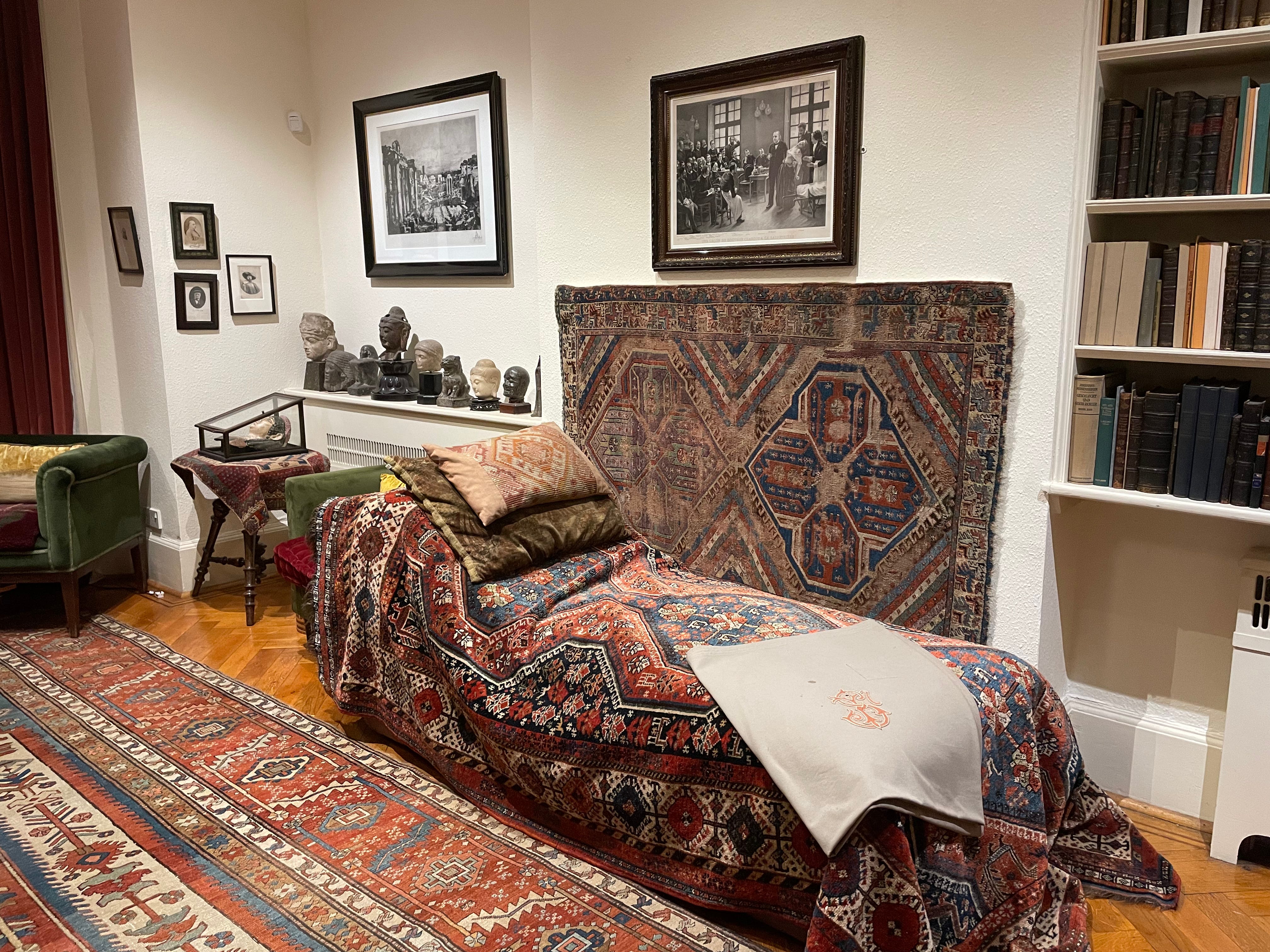
It is a rare privilege to be in two places at once, but as I step into the living room of this cozy house in North London, I suddenly feel transported to Berggasse 19. It is covered with an old, carpet-like throw, and I can hardly imagine that so many years ago, nearly a century now, it brought relief to the desperate, because when I look at the couch today, I immediately start itching all over, and still here it is before me, the original.
I have been to London so many times, yet I never managed to come here before, because the journey here is nearly as exhausting as traveling from the center of Vienna into the mountains, except that the Underground here has no air conditioning and the double-decker bus rattles dangerously around every bend.
In 1938, the Freud family, Martha, the daughter Anna, the housekeeper Paula Fichtl, and of course Sigmund himself, already terminally ill at that point, brought the couch here together with everything else that could be transported. One of the sons had organized the house, complete with its wonderful garden, in advance.
Although black-and-white films of the escape from Vienna via France to London survive and are shown upstairs, in what used to be Anna Freud’s salon, it is difficult to imagine how the family managed to evacuate the couch, large parts of the mineral collection, as well as numerous books and other belongings, and not least the gravely ill Sigmund himself.
Even harder to comprehend is that it was possible to save all of this while having to leave Sigmund’s three sisters behind in Nazi Germany, where they were eventually murdered — not because their lives seemed less worth saving to their relatives, but less worthy of rescue to the authorities.
So there it stands, the battered couch, and I cannot help but feel a slight disappointment, so inconspicuous and unspectacular is the old piece of furniture in the middle of this large room. Besides, it is not the only couch in the room. At the other end stands another chaise longue, which presumably served Dr. Freud himself, distracting attention from the real couch, the actual one, because the visitor must first orient herself to determine which couch is the famous one.
I look at the greasy wall hanging draped over the real couch, and like a filter the image of the fake couch, the replica in Berggasse 19, overlays it. The false couch in the right place somehow feels more real than the real couch in this wrong place.
Nor does it change anything that flowers are blooming outside the window in the well-kept garden and the trees are providing shade on this hot day. Freud, too, must have appreciated the cooling effect of the trees when he arrived in England in June 1938. In the films he can be seen in an armchair in the garden, which according to his daughter was his favorite spot.
Every summer in Vienna, he and Martha had fled from Berggasse to the suburbs. He had always dreamed of a garden like this one, only it might have been somewhat closer to Berggasse, like the couch, which here in this foreign place feels lost and unreal.
Perhaps that, too, was one of the reasons, besides the unspeakable pain caused by his cancer, that little more than a year later, in September 1939, even the shadows of the trees in his London garden had grown too long for him.